


Word Relax: Word Puzzle Games
MASTERMIND WORD GAMES
My first impression of Word Relax: Word Puzzle Games was that it understands the appeal of a small, quiet word challenge. I open it, look for a way into the puzzle, and start testing letters without needing to prepare for a long session. That simple beginning is the main attraction: the game gives me something to think about immediately, then lets me stop before the activity becomes a commitment.
This is a free word game from MASTERMIND WORD GAMES, aimed at Everyone and available for Android devices running at least Android 7.0. It has built a strong audience, with an average rating of 4.8 from around 7,100 ratings and more than 100,000 installs. Those figures do not replace personal experience, but they do suggest that the relaxed format has connected with many casual players.
I would describe it as a good fit for people who enjoy arranging, guessing, and recognizing words more than competing in a demanding timed contest. The important question is not whether it contains the deepest word-game system available. It does not try to be that. The better question is whether its repeating cycle of action, feedback, reward, and reset makes you want to solve one more puzzle. In my experience, that is where its value becomes clear.
How the first move sets the tone
The first action in a session is deliberately approachable. I begin by examining the available letters and trying to see possible connections rather than memorizing a complicated rule set. That makes the game easy to pick up when I have only a few spare minutes. I do not need the concentration required by a large crossword, and I am not immediately pushed into a high-pressure race against another player.
That accessibility is especially useful on an ordinary day. Imagine waiting for an appointment with your phone in one hand and only a short break available. I can start a puzzle, make a few attempts, and either continue if the pattern is taking shape or put the phone away without feeling that I have abandoned a major task. The low entry cost is one of the most convincing reasons to keep this game installed.
Related News






The word-puzzle format also gives the opening move a pleasant sense of possibility. A group of letters can look unhelpful at first, then one familiar combination suddenly makes the rest easier to see. I enjoy that moment because the game rewards observation rather than frantic tapping. It encourages me to slow down, scan the board, and consider alternatives before committing to an answer.
That said, players who want a detailed tutorial, a competitive ranking system, or a very distinctive rule twist may find the opening too modest. The straightforward design is a strength for casual use, but it can also feel familiar if you already spend time with crosswords, anagrams, or other daily word challenges. This is more about making the basic loop comfortable than reinventing the genre.
Why the controls matter more than they seem
In a word game, the controls should almost disappear. My attention should stay on the letters, not on figuring out how to submit a move or recover from a mistaken touch. Word Relax benefits from that kind of direct interaction. The less effort I spend managing the interface, the more mental space I have for spotting words and testing ideas.
Gallery
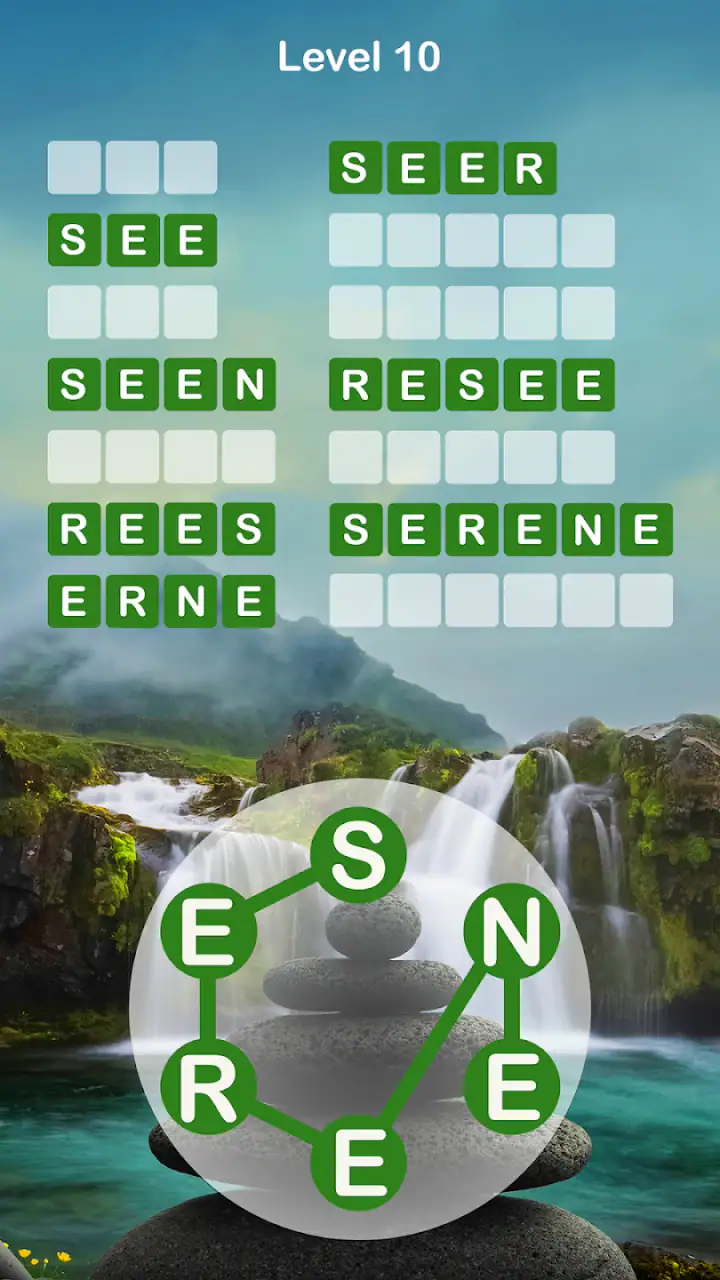
There is also a useful difference between a game that asks me to guess randomly and one that lets me build a hypothesis. Here, I can begin with a likely word, see how the puzzle responds, and use that response to refine the next attempt. That makes the first action meaningful even when it is wrong. A failed guess is not necessarily wasted time; it can narrow the possibilities and reveal how I should look at the remaining letters.
My practical tip is to resist the urge to submit the first word that comes to mind. I get better results by checking shorter combinations first, then looking for repeated patterns or familiar endings. This is not a hidden feature, but it changes the feel of the game. Instead of tapping until something works, I treat each move as information. That approach makes the puzzle calmer and gives the feedback more value.
The feedback rhythm keeps the puzzle moving
After the first move, the most important part of the experience is the rhythm of feedback. I make an attempt, learn whether it helps, and immediately adjust my thinking. That sequence creates a small conversation between the puzzle and me. The game does not need a dramatic presentation to hold my attention; the changing state of the word challenge is enough to create momentum.
Good feedback in this type of game should do two things at once. It should confirm progress clearly, and it should leave enough uncertainty for the next decision to remain interesting. Word Relax works best when I am close to a solution but not completely certain. I can see that my reasoning is moving in the right direction, yet I still have to choose the next useful combination.
This is where the game feels more relaxing than many alternatives. A timed word title turns every pause into a cost. A competitive multiplayer format makes each mistake feel public or consequential. A traditional crossword can demand a much longer chain of attention. Word Relax sits in a softer middle ground: there is still a problem to solve, but the pressure comes mainly from my own curiosity.
The trade-off is that a relaxed feedback rhythm may not satisfy players who need constant intensity. If you prefer countdowns, head-to-head matches, or increasingly punishing challenges, the slower pace could feel underpowered. I would choose a more competitive word game when I want adrenaline or a clear performance comparison. I choose this one when I want my attention occupied without turning the session into a test.
Using mistakes as useful clues
One of my favorite ways to approach a puzzle is to treat an incorrect attempt as a clue rather than a setback. I look at what the move tells me about the structure of the challenge, then change one part of my approach at a time. That prevents the common word-game habit of repeatedly trying unrelated guesses. The result is a more deliberate loop: action, information, adjustment, and another action.
This method is particularly helpful when I am mentally tired. Instead of demanding that I instantly see the answer, the game lets me arrive there through smaller discoveries. It also gives the session a gentle learning quality. I become more aware of common word shapes, likely letter pairings, and the difference between a word that looks plausible and one that actually fits the puzzle.
A second practical tip is to change perspective when I stall. I stop staring at the letters in the same order and search for a different starting point. Sometimes I focus on a recognizable ending; sometimes I look for a short word hidden inside a larger possibility. This simple reset of attention is more effective than tapping faster, and it suits the thoughtful character of the game.
The limitation is that the feedback loop depends on enjoying gradual discovery. If you want explicit explanations for every answer or a strong educational vocabulary system, this may not go far enough. It can sharpen observation and word familiarity through repetition, but I would not treat it as a structured language course. Its reward is the solving process itself.
What makes completing a puzzle feel rewarding
The reward in Word Relax is modest but satisfying: I recognize the solution, complete the immediate task, and get the mental release that follows a small problem being resolved. That feeling is easy to underestimate. Because the puzzles are compact, the game can provide a clear sense of completion without asking me to dedicate an entire evening.
I also like that the reward comes from understanding rather than from spectacle. The enjoyable moment is often the instant when several loose letters become a coherent word. That kind of recognition feels personal because I have done the work of noticing the connection. It is a different pleasure from collecting elaborate equipment, climbing a competitive ladder, or chasing a complicated achievement system.
For everyday use, this makes the game a useful transition activity. I can play a little after finishing work, during a quiet breakfast, or while taking a short break from a more demanding task. The word puzzle gives my mind something structured to do, but it does not require the emotional investment of a story-driven game. I come away feeling occupied rather than overwhelmed.
The reward also works because the game has a natural stopping point. A completed puzzle feels like a clean unit of progress. I do not have to stop in the middle of a long level just because real life interrupts me. For people who often play in short bursts, that matters more than a large amount of content presented without convenient boundaries.
Where the free model enters the experience
The game is free to download and play, while in-app purchases range from $0.99 to $49.99 per item. That makes it easy to try without paying at the start, but it is worth remembering that the optional purchase range includes both small and much larger transactions. I would advise setting a personal spending limit before using any extras, especially if you tend to make quick purchases when stuck or when you want to speed up progress.
For me, the best way to judge the game is to use the free experience first and ask whether the basic puzzle loop is already enjoyable. If I need to pay before I can decide whether I like the core activity, that is a warning sign about my own expectations. A word game should earn continued attention through the quality of its solving cycle, not simply through the promise of additional convenience.
This is also where the app may not suit everyone. Players looking for a completely purchase-free experience should examine the in-game options carefully before committing time. On the other hand, someone who wants a casual word game and is comfortable with optional spending may find the model reasonable, provided purchases remain deliberate rather than impulsive.
Why the reset brings me back
After a puzzle ends, the reset is the bridge to the next session. I am no longer solving the previous arrangement, but I still have the mental habit active: scan, test, interpret, and complete. That makes it easy to begin again. The next session does not require a dramatic reason. Sometimes I simply want another small challenge while the satisfaction of the last one is still fresh.
This reset works particularly well when I use the game as a break between tasks. I might finish one puzzle, put the phone down, and return later with a clean mind. Because the activity is based on words rather than a complicated control scheme, I can re-enter without remembering a story, a map, or a set of temporary objectives. The continuity comes from the familiar thinking pattern.
There is a possible downside to that convenience. A short, low-pressure puzzle can become an easy way to delay something else. I have found it helpful to decide in advance whether I am playing one puzzle or taking an open-ended break. The game is relaxing partly because it has few barriers to another round, so self-control matters more than it would in a title with long loading times or a fixed match length.
Another useful habit is to stop after a satisfying solve rather than continuing until every puzzle feels routine. That preserves the sense of discovery. If I keep playing while tired, the activity can shift from calming to repetitive. Word Relax is strongest as a flexible companion for short mental pauses, not necessarily as the only game I play for hours.
Who will get the most from repeated sessions
I would recommend it to casual word-game fans, people who enjoy anagram-style thinking, and anyone who wants a quiet activity that can fit around a busy schedule. It is also a sensible option for households looking for an Everyone-rated game that does not depend on violent action or complex competitive mechanics. The low age rating and simple premise make it approachable, while the word-solving loop still gives adults enough room to think.
I would be more cautious about recommending it to expert crossword players who expect dense clues, layered themes, or a high degree of linguistic difficulty. I would also point competitive players toward a game built around live matches, timers, or rankings. The appeal here is not proving that I am faster than someone else. It is finding a word, receiving a useful response, and enjoying the small reset that invites another attempt.
Compared with a daily word challenge, this game feels less tied to a single ritual. A daily format can create anticipation and a shared conversation, but it can also make a missed day feel like a break in the routine. Word Relax is more flexible for me: I can open it when the moment suits me. Compared with a full crossword, it demands less sustained concentration but may offer less depth. Compared with an anagram race, it gives up urgency in exchange for a calmer pace.
That comparison explains its place in my library. I would not replace every other word game with it. Instead, I use it when I want the mental shape of a puzzle without the pressure, length, or competitive focus that other formats bring. Its value is situational, and that is not a weakness when the situation is exactly a spare few minutes and a desire to unwind.
My verdict on the complete action-to-reset loop
Word Relax succeeds because its cycle is easy to understand and pleasant to repeat. I make a first attempt, watch the puzzle respond, use that information to refine my thinking, and enjoy the completion when the answer falls into place. Then the session resets cleanly, leaving me with the option of another short challenge rather than forcing a long commitment.
The game is not the best choice for players who want advanced crossword construction, intense competition, or a completely different word mechanic. Its straightforward approach can feel familiar, and the optional purchase range means I would pay attention to spending choices. Those are real limitations, especially for users who expect a deep vocabulary system or a strongly defined endgame.
For the right player, though, the simplicity is exactly the point. MASTERMIND WORD GAMES has made a free, accessible word title that fits naturally into small breaks and quiet routines. The current version is 2.2.4, and the game has been available since November 30, 2020, giving it an established presence rather than the feel of a brand-new experiment.
My final recommendation is to try it when you want a gentle puzzle rather than a demanding challenge. I would open it during a commute, after a tiring task, or whenever I wanted to replace aimless scrolling with a few minutes of focused thought. If the pleasure for you is the calm chain from guess to clue to solution, this is a worthwhile word game to keep nearby.
FAQs for Word Relax: Word Puzzle Games
What is Word Relax: Word Puzzle Games?
Word Relax: Word Puzzle Games is a casual word-search and vocabulary game designed for short, relaxing play sessions. It typically asks you to connect or arrange letters to discover hidden words, complete levels, and progress through themed puzzles. The gameplay is easy to understand, but later stages can require stronger vocabulary, careful observation, and strategic use of available letters.
How do you play Word Relax: Word Puzzle Games?
To play, examine the letters shown on the screen and swipe across them or tap them in the correct order to form valid words. Completing the required words lets you solve the current puzzle and unlock additional levels. Some stages may include bonus words that are not necessary for completion but can provide extra rewards, making exploration worthwhile when you have time.
Is Word Relax: Word Puzzle Games free to download and play?
The game can generally be downloaded and played without an upfront purchase, although free versions may include advertising, optional in-app purchases, or both. Ads can appear between levels or when you request extra hints, while purchases may offer coins, boosters, or an ad-free experience. Before downloading, check the current store listing for pricing and purchase details.
Can Word Relax: Word Puzzle Games be played offline?
Many of the basic word puzzles may remain playable without a continuous internet connection, which makes the game convenient for travel, commuting, or areas with unreliable service. However, certain features—such as advertisements, cloud progress, rewards, updates, or promotional content—may require internet access. Offline availability can also vary by version and device, so test it after installation.
Is Word Relax: Word Puzzle Games suitable for children and language learners?
The simple controls and calm puzzle format can make Word Relax suitable for many children, casual players, and people who want to practice recognizing English words. Nevertheless, difficulty and vocabulary vary, and younger users may encounter unfamiliar terms or advertising. Parents should review the store’s age rating, privacy information, and purchase settings before allowing children to play independently.
Pros
- Relaxing gameplay suitable for short breaks or casual sessions.
- Simple controls make it easy for beginners to start playing.
- Word challenges can help improve spelling and vocabulary over time.
- Offline play may be convenient when you have limited internet access.
- Progressive difficulty keeps the puzzles engaging as skills improve.
Cons
- Some puzzles may feel repetitive after extended play.
- Hints and other helpful tools may be limited without extra resources.
- Difficulty can vary noticeably between consecutive levels.
- Ads may interrupt gameplay
- especially between completed puzzles.
- Players seeking competitive multiplayer may find the experience too solitary.


